The ARROW Footrest began with extensive user interviews. We spoke with undergraduate students who struggled to find comfort at their desks — in dorms, libraries, and study spaces. One key insight: students under 5'3" had no good way to rest their feet while working at standard-height desks. This drove our focus toward a portable, chair-mounted solution rather than a floor-standing footrest that would take up space.
Back to Projects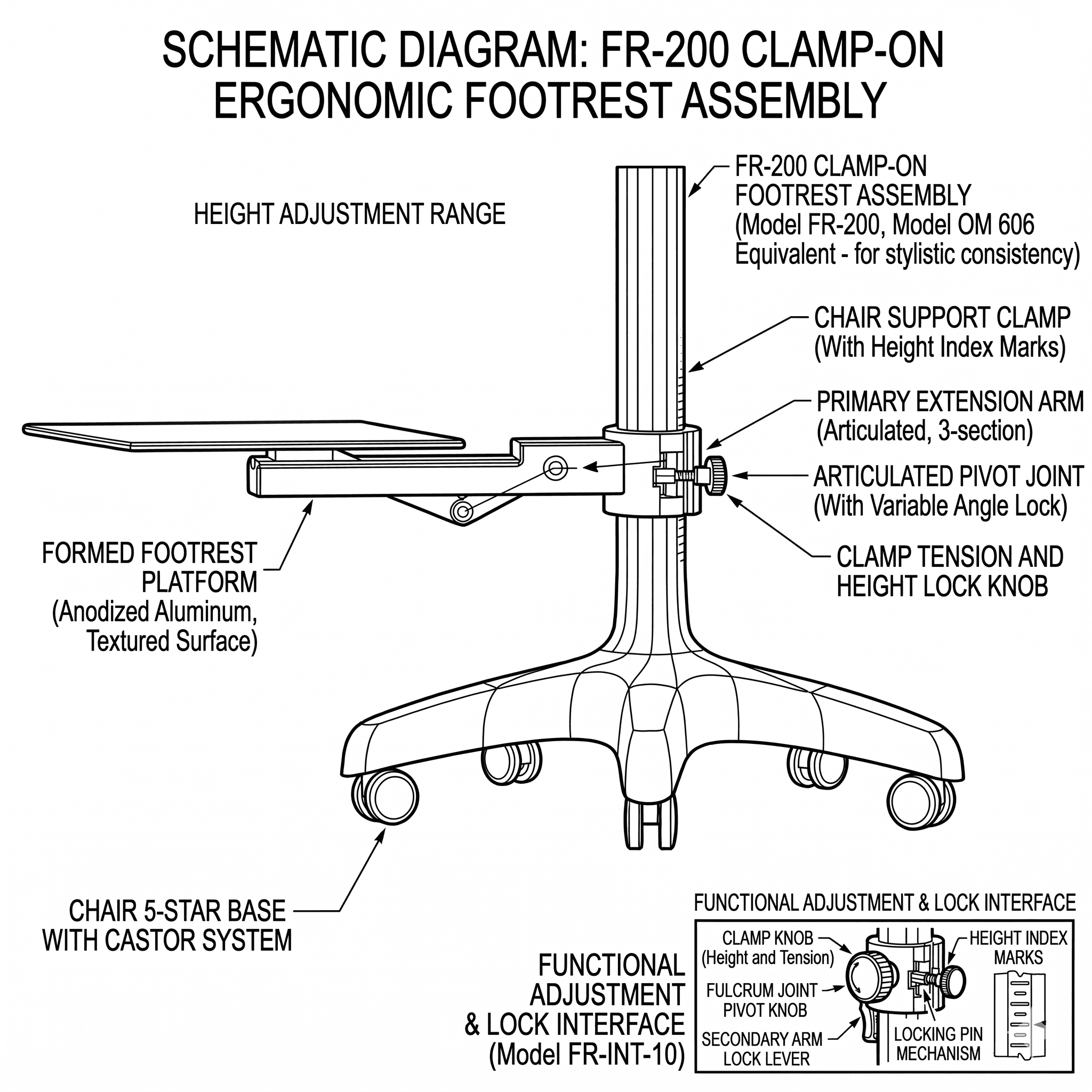
ARROW FOOTREST DESIGN
Design Team MemberAug 2023 – Nov 2023
Human-Centered DesignCADInjection MoldingSheet MetalGD&T
"As part of a four-person team in ME170 (Design for Manufacturing), I helped design the ARROW Footrest — an adjustable, chair-mounted footrest that prioritizes comfort and modularity. We took the project from user interviews through CAD modeling and manufacturing planning."
Engineering Deep Dive
We sketched four distinct concepts: a screw-clamp hinge design, a single-clamp with rubber stopper, a dual-clamp for 4-leg chairs, and a body-weight-secured folding design. Using a Pugh matrix with 11 criteria — from service life to manufacturing complexity — we systematically evaluated each against a datum. Concept 3 (dual-clamp) scored highest, but we iterated significantly to adapt it for office chair bases based on interview feedback.
The final design consists of a modular assembly: a slider mechanism with steel base and ABS plastic components, a pipe-style clamp with eye bolt adjustment, and a replaceable platform. I focused on the clamp and linkage geometry in SolidWorks, ensuring the mechanism could handle 40 lbs of vertical force with less than 1.5" deflection. The modular approach means users can swap platforms or replace individual components without buying a new footrest.
Material selection balanced durability against cost. Load-bearing components like the slider rail use stamped steel sheet metal, while the platform and pins use injection-molded ABS plastic for safety and weight reduction. We specified H7/g6 sliding fits for pin-hole interfaces (0.05-0.29mm clearance) and H7/k6 transition fits for the slider pan-rail interface to maintain contact under load. Target manufacturing cost under $20 enables our $30 retail price with required margins.
Every custom part received a detailed engineering drawing with full GD&T callouts per ASME Y14.5M-2018. The drawings specify tolerances achievable with standard machine tooling — we weren't designing for aerospace precision, but for reliable manufacturing at scale. The complete documentation package includes exploded assembly views, cross-sections showing internal fits, and a bill of materials with off-the-shelf hardware identified.
CONTACT
Let's Build Something Great
I'm currently working at Tesla, but I'm excited about the possibilities for the upcoming summer! Whether you have a question about my work or want to discuss a project, my inbox is open.