The front wing mounting struts are the structural connectors of the aero package to the car. They carry all downforce, drag, and side loads from the wing directly to the monocoque. They essentially are a vital load path that transfer all the downforce the wings develop to the vehicle making them critical components on the aero package.
Back to IEM Projects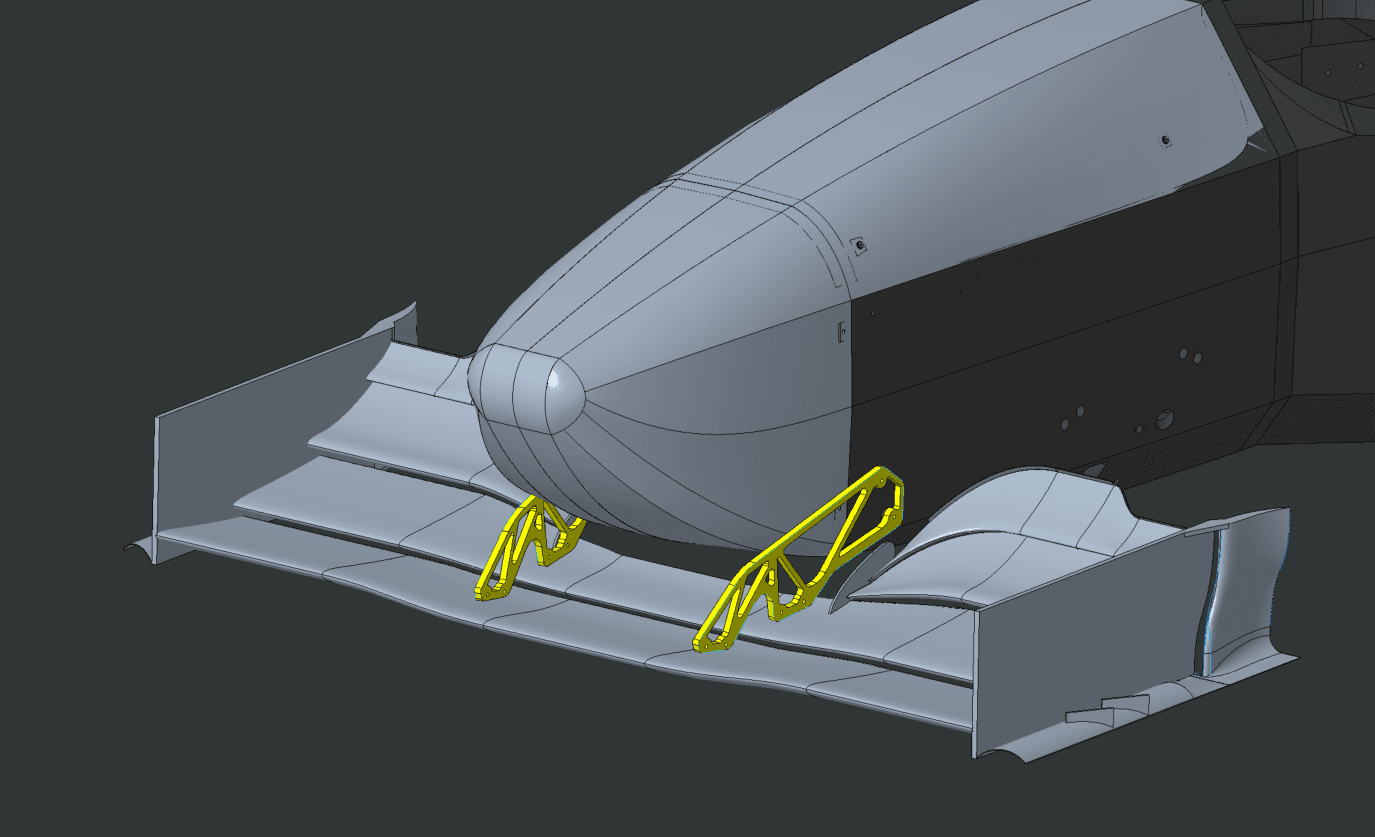
FSAE | FRONT WING MOUNTING STRUTS
Structures EngineerAug 2024 – Present
Topology OptimizationFEAAnisotropy AnalysisStructural Design
"A deep dive into replacing failure-prone CFRP mounting struts with topology-optimized aluminum counterparts. This project highlights failure analysis, yielding behavior over catastrophic fracture, and achieving a 58% mass reduction through iterative optimization."
Engineering Summary
The Problem
The previous carbon fiber mounting struts fractured catastrophically under cone strikes — no warning, immediate disqualification risk.
My Approach
Replaced CFRP with topology-optimized 6061 aluminum waterjet-cut from flat stock, sized for yielding (warning) rather than fracture.
Key Result
58% volume reduction (18.96 in³ → 7.91 in³), SF 1.6 to yield, deflection held under 0.1" at 95 mph.
Design Constraints & Specifications
Stiffness Target< 0.1" Z-deflection at 95 mph aero loads
Strength TargetSurvive 35 mph aero + cone strike combined
ManufacturingWaterjet-cut from flat aluminum sheet stock
Safety Factor1.6 to yield (intentional — warn before fracture)
ServiceabilityMust be replaceable trackside without disassembly
Engineering Deep Dive
The struts had two design-driving load cases. The first was stiffness: the struts had to keep wing deflection within an acceptable limit at peak aero loading of 95 mph. If the wing flexes too much, it deviates from its designed profile and bleeds aerodynamic performance. The second was strength: the struts had to survive the harshest combined load case—35 mph aero loads simultaneously with an out-of-plane cone strike. This combination represents the worst credible event on track. If these parts failed and the wing dropped to the ground mid-run, it was an immediate disqualification.
When sizing for strength, the active constraint was exactly what you'd expect: the 35 mph aero load combined with the cone strike. The aero-only case was no problem—the cone strike component is what actually pushes the part to its limits.
The first question when designing the strut was what it'shape should like? The idea was to maximize area moment of inertia where requried. The idea I used was to think of the struts as a cantilever beam fixed the chassis at one end. There were really two main forces that caused the part to bend, the out of plane cone strike and the downforce. The key equation here is the area moment of inertia and its relationship to deflection:
I = l·w³/12 → δ = F·L³/(3·E·I)
For when trying to reduce the bending because of aero loads, the width of the beam (w in the diagram) had a cubic relationship with moment of inertia. So increasing it's width allowed for much lesser deflection. This drove the decision to use a taller section of aluminum sheet rather than going flat. The shape of the strut evolved directly from this reasoning—maximize the section height wherever packaging would allow.
At one point during the initial design phase, I explored a weight-saving approach: mount the main struts only to the second mainplane (the one closest to the chassis), and then use smaller, lighter brackets between the two mainplanes to transfer the load forward. Intuitively, at first, I thought this would work and provide significant weight savings.
In practice, I didn't realise that this arrangement made the first mainplane act as a simply supported beam with a massive distributed aerodynamic load across its entire span. Simply supported beams deflect with an L⁴ relationship to span, and at our scale of 50" length, the resulting deflection was a huge no-go. I've attached a photo to show how significant the smile created was. The whole forward section of the wing was bowing like a banana. The idea was scrapped entirely, and the struts were redesigned to mount directly to both mainplanes, distributing the load properly and eliminating the problematic span.
To properly optimize and size the parts, accurate boundary conditions reflecting both aerodynamic loads and dynamic track scenarios were applied.
With the geometry philosophy locked in, the next step was picking the right sheet aluminum thickness. I tested a range of thicknesses bracketing my intuitive estimate—below it to check where the design started failing margin, and above it to find where the added weight and aerodynamic blockage started becoming detrimental. There's a real upper limit on thickness here: at some point the strut becomes thick enough that it starts generating its own drag and interfering with airflow entering the wing, which defeats the purpose of having a wing at all.
Once the right thickness was identified, I ran topology optimization in Ansys. Manufacturing constraints were set from the start: these parts were going to be waterjet-cut from sheet stock, so the optimizer couldn't propose anything that couldn't be cut flat. Pockets were iteratively removed from low-stress regions, and the remaining material was verified to meet the strength and deflection requirements. Bolt holes were then sized for both bearing stress and shear tearout to make sure the fastener interfaces were never the weak link.
Achieved a 58% volume reduction through topology optimization — from 18.96 in³ to 7.91 in³.
Part sized to a Safety Factor of 1.6 to yield under the active constraint (35 mph aero + cone strike), providing a warning before fracture.
Strut deflection held within the 0.1" Z-limit at 95 mph aero loads.
Bolt holes verified for both bearing stress and shear tearout to a safety factor of 2.
Mounting location kept to the side of the monocoque and not the floor so if a part yielded, it could be unbolted and replaced trackside without major disassembly.
Scrapped the single-mainplane mounting concept early after identifying the catastrophic simply-supported beam deflection it caused.
CONTACT
Let's Build Something Great
I'm currently working at Tesla, but I'm excited about the possibilities for the upcoming summer! Whether you have a question about my work or want to discuss a project, my inbox is open.