Our 21-element aero package build relied heavily on "tribal knowledge" held by a few senior members. With a 9-member team of varying experience, this lack of documentation led to high scrap rates and inconsistent part weights. We also spotted severe "bridging" defects (resin-rich zones lacking fiber) on the leading edge radii of cured parts in split molds.
Back to IEM Projects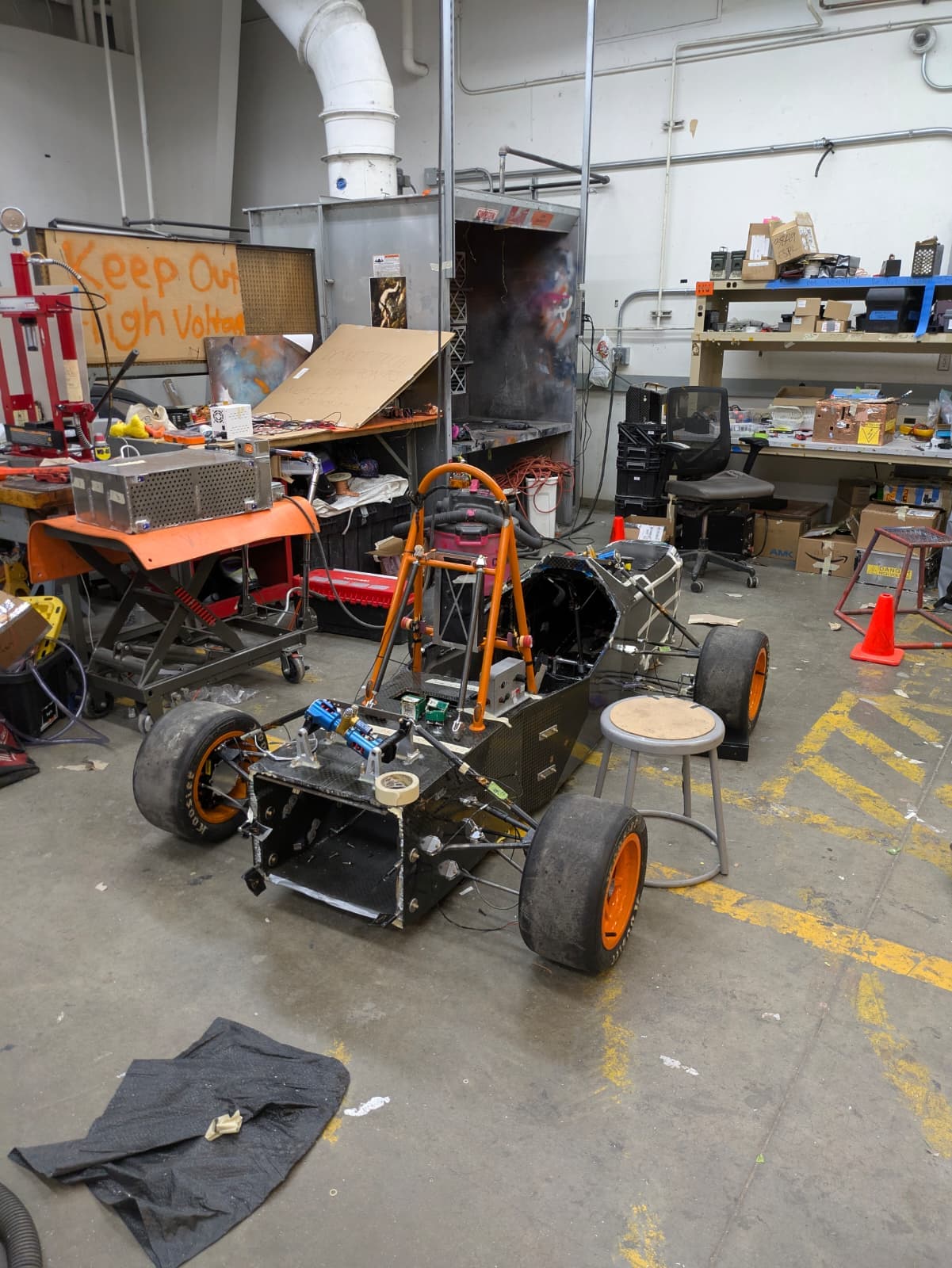
FSAE | MANUFACTURING & DFM
Structures EngineerAug 2024 – Present
Design for ManufacturingComposites FabricationAssembly
"This page just has some photos documenting the manufacturing processes I've worked on. I've had the opportunity to work extensively on composite layups. Processes like prepreg mold layups, sandwich panel flat stock, and resin infusion layups."
Engineering Deep Dive
Standardize the fabrication process by moving from a "craft" mindset to a "production" mindset, ensuring Part #1 and Part #21 are identical in quality while maximizing carbon fiber utilization.
I developed a comprehensive Standard Operating Procedure (SOP) manual on the team wiki, integrating CAD dimensions, step-by-step checklists, and high-resolution bagging photos. To fix the leading edge bridging, I performed a Root Cause Analysis and identified that standard bagging didn't account for the mold's vertical "draw". I updated the SOP to mandate pleats (intentional bag slack) into deep crevices. Finally, I utilized deepnest.io to automate ply nesting, breaking large 45° plies into smaller sections that were butt-joined to eliminate relief cuts and waste.
The front wing's 45° plies were too large to cut from a single sheet of prepreg without massive waste. I broke the full-span plies into smaller, optimally-shaped sections that could be butt-joined during layup. This allowed us to nest everything tightly on the available material, drastically cutting scrap.
Ply Breakdown
A sketch showing how the full-span plies on the front wing are broken down into smaller sections for efficient material usage.
Nested Layout
The final nested layout of all broken plies, optimized using deepnest.io to maximize carbon fiber utilization and minimize prepreg waste.
The SOP and optimization efforts fundamentally changed our shop floor operations.
Eliminated tribal knowledge, allowing junior members to reliably build flight-grade components.
Reduced total prepreg material requirement from 200 ft to just 60 ft — a 70% material savings.
Achieved a ~65% carbon utilization rate using digital nesting.
Eliminated leading-edge bridging defects entirely across the remaining 20 aero elements.
CONTACT
Let's Build Something Great
I'm currently working at Tesla, but I'm excited about the possibilities for the upcoming summer! Whether you have a question about my work or want to discuss a project, my inbox is open.