Back to IEM Projects
FSAE | INTERNAL STRUCTURES & PACKAGING

FSAE | INTERNAL STRUCTURES & PACKAGING

Structures EngineerAug 2024 – Present
Design for ManufacturingWaterjet Flat-StockCompositesCrash Survivability

"Engineering the front wing's internal skeleton for manufacturability by replacing complex 3D I-beams with waterjet-cut flat-stock and self-aligning cross-lap joints, while selecting Corecell M80 to survive cone strikes."

My Journey

1

Failure Analysis: The Need for Internal Structure

To understand the necessity of a robust internal skeleton, I analyzed the failure points on last year's front wing. The absence of proper internal structuring led directly to catastrophic skin failure.

Previous Manufacturing Flaws

The original design featured relief cuts in the carbon fiber front wing that acted as stress concentrations. These cuts were made to ease manufacturing, but they created significant weak points in the skin.

The Y-Axis Moment Failure

Further analysis revealed that the wing cracked because there was no internal spar designed to handle the moment in the Y-axis. The out-of-plane forces from steering and cone strikes overloaded the skin plies, which naturally failed at the manufacturing relief cuts.
2

The Problem: The Tolerance Stack-Up

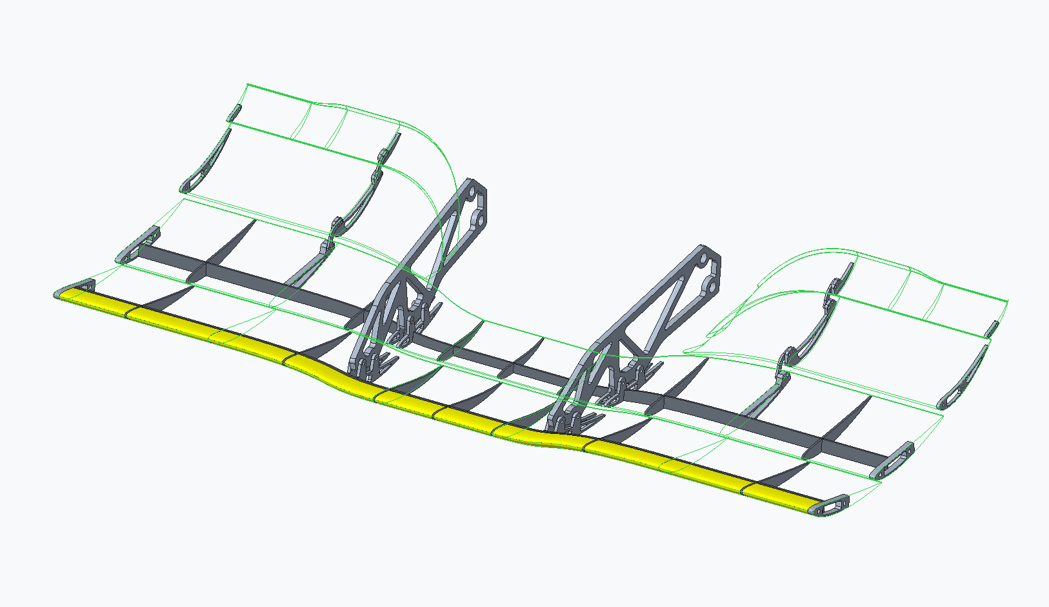
Under extreme aerodynamic stresses, a wing's internal ribs and spars are what hold it together. Previously, these were complex 3D structures (curved I-beams and C-channels). These were structurally efficient but a nightmare to manufacture and even worse to assemble. They required separate molds, were extremely difficult to layup perfectly against sweeping wing contours, and depended on sequential placement during bonding. This caused massive tolerance stack-up issues. Thermal expansion, imperfect prep/layup, and excessive bonding surfaces meant using heavy adhesive and poly-filler to fix gaps, destroying our weight margins.
3

The DFM Pivot: Flat-Stock & Slots

To guarantee we could reliably hit our tight production timeline, I pivoted the internal spars and ribs to 2D flat-stock carbon fiber plates. While curved I-beams are stiff, flat plates don't require molds, they are laid up flat on a table, which completely significantly reduces scrap rate and other massive layup complexity. The only curved regions were precision-cut using a waterjet so you know they are true to CAD. To compensate for the slight drop in geometric stiffness against the curved alternatives, we implemented a 5 ply spar.
4

The Assembly Solution

To fix the sequential tolerance stack-up problem, I engineered an interlocking cross-lap joint system. The flat-stock ribs and spars featured opposing slots that acted as a self-aligning mechanical fixture. Instead of parts stacking sequentially and pushing tolerances outward, every rib effectively 'clips' mathematically onto the main continuous spar. We used Hysol EA 120 structural adhesive to lock the joints—cutting down layup and assembly time significantly.
5

Crash Survivability: Corecell M80

The front wing leading edge is the first point of impact. In the past, brute-force carbon or brittle foams would shatter completely on a cone strike, and Kevlar would frill, making surface repairs impossible. After evaluating 13 different foam options for the leading-edge core, I selected Corecell M80. It possesses a 40% elongation at break, meaning its compressive and absorption strength allow it to deform and absorb energy plastically beneath the carbon skins rather than fracturing catastrophically.

Gallery

CONTACT

Let's Build Something Great

I'm currently looking for new opportunities in mechanical design and analysis. Whether you have a question about my work or want to discuss a project, my inbox is open.