Back to Projects
ILLINI ELECTRIC MOTORSPORT | FSAE

ILLINI ELECTRIC MOTORSPORT | FSAE

Front Wing Structures LeadAug 2024 – Present
Carbon FiberCompositesFEA - Ansys ACP/MechanicalPTC CreoMotorsport+2 more

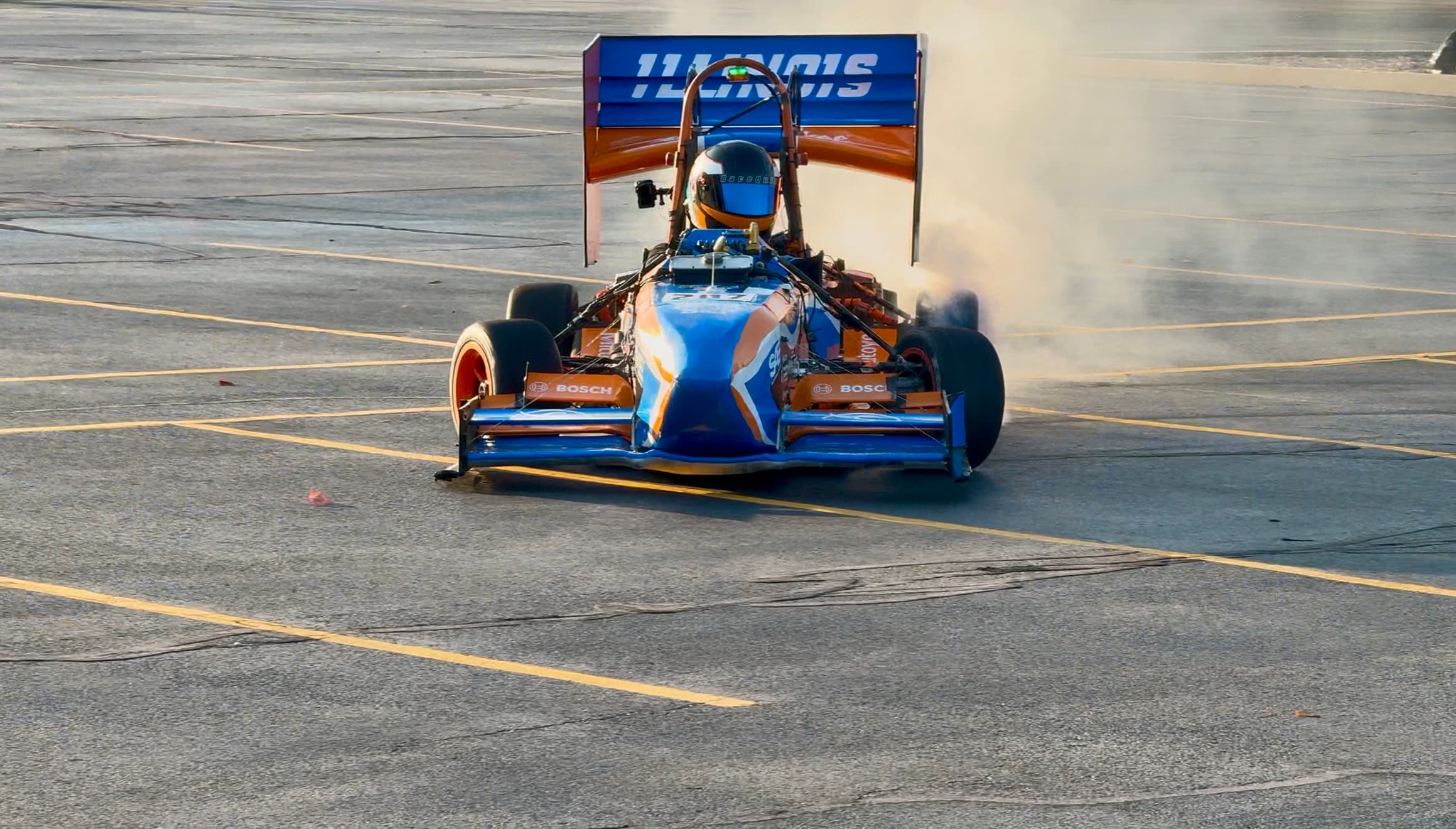
"Leading the front wing structures sub-team for Illini Electric Motorsport, I designed, analyzed, and manufactured the carbon fiber front wing assembly — including skins, internal ribs, spars, struts, and inserts — for our 2026 electric formula race car."

My Journey

1

Design Goals & Constraints

  • Surface deflection ≤0.125" under 95 mph aero loads (prevents deviation from designed airfoil profile)
  • Minimized spanwise bowing on the first mainplane (50" unsupported span = L⁴ scaling problem)
  • Cone strike survival — front wing must not shatter on impact (lessons from last year's brittle failure)
  • First natural frequency ≥3× dominant road input (15+ Hz target)
  • FSAE Rule T.7.1.3: All aero devices must remain stable without excessive oscillation
  • Rule IN.6.6.2: 200N proof load with <5mm permanent deflection
  • Internal SR.1-4: Positive safety margins under combined aero, inertial, and cone strike loads
2

Learning from Last Year's Failures

Strut Failure (Carbon Anisotropy)

Initial Idea:Switch to aluminum vs. continue with carbon?
Solution:Manufacture both aluminum and carbon struts — carbon as primary, aluminum as reinforced backup.
Why:Aluminum's isotropic behavior ensures predictable failure modes if carbon snaps during competition.

Front Wing Shatter

Initial Idea:Use CF + Aramid hybrid layups for impact absorption?
Solution:Introduce a Corecell-lined leading edge.
Why:Aramid fibers frill and fray after impact, preventing clean aero geometry for repairs. Corecell absorbs energy efficiently via deformation.
3

FEA Exploration & Initial Solutions

I ran FEA on the new airfoil geometry with a 3-ply schedule to understand deformation behavior. Key Finding: Extreme spanwise deformation — the first mainplane was acting like a simply supported beam with distributed load. Max deflection scales as L⁴ where L ≈ 50" (span between mounting points). Solutions Explored: 1. Safety cables on endplates to restrict deflection at the wingtips. 2. Carbon spars at the center of pressure (cP) of each wing for flexural rigidity. 3. Rib placement optimization to minimize surface deformation. (In the visualization to the right: light grey = aluminum, dark grey = carbon, yellow = corecell foam. Note: This initial FEA had additional connections making the result non-conservative.)
4

Internal Structure Strategy

The wing's internal structure had to absorb inertial loading, aero forces, and cone strikes. I evaluated 13 foam options (Rohacell, Corecell, Gurit PVC) to find a solution that could match our complex geometry. Decision: Selected Corecell M80 (3mm) for the leading edge core. Reasoning: Unlike honeycomb which cannot conform to tight airfoil radii, or brittle foams that shatter, Corecell offers high elongation at break (40%) — allowing the leading edge to deform and absorb energy during a cone strike rather than fracturing. The ribs and spars were waterjet-cut from flat sandwich stock (Corecell + Carbon), enabling rapid manufacturing from single sheets.
5

The Dual-Mainplane Mounting Decision

Extreme Bowing

Initial Idea:Mount struts only on the first mainplane (legacy weight saving).
Solution:Switch to dual-mainplane mounting struts.
Why:The 50" simply supported span caused 'smile-shaped' bowing due to L⁴ scaling. Dual mounting cut the unsupported span effectively.
6

Ply Schedule & Material Selection

ComponentMaterialPly ScheduleDesign Rationale
Mainplane 1TC 250[45, -45]Torsional Stiffness
Mainplane 2TC 250[45, -45]Torsional Stiffness
ElementsTC 250[0, 0]Flexural Rigidity
SparsTC 275[0,0,0,0,0]Flexural Rigidity
Mounting Inserts7075 Al1C1 [0.125" core]Buckling Resistance
EndplatesTC 250[0, -30]Flexural Rigidity
7

Validation & Results

Surface deflection maintained below 0.1" (Goal: ≤0.125")
Spanwise bowing reduced — total deformation within limits
All safety margins positive under combined loading
Buckling issue identified on MP1 — Patch ply solution implemented
Every fastener safety-factored and validated
Custom inserts designed for all wing attachments
8

Manufacturing & Current Status

Design is 90% complete and manufacturing has now begun. Our approach involves adding a layer of peel ply on the inside of the skins to prep the surface for bonding. The internal structures (ribs and spars) connect together in an almost lap-joint method, allowing adhesive to be added for secure bonding. The assembly sequence proceeds from skin layup to peeling the interior, followed by bonding the ribs/spars and final close-out.

Gallery

CONTACT

Let's Build Something Great

I'm currently looking for new opportunities in mechanical design and analysis. Whether you have a question about my work or want to discuss a project, my inbox is open.