Sizing the front wing assembly to an arbitrary target like "maximum deflection under 0.5 inches" is flawed when sizing aero structures. The wing deforms in 3D: surface deformation alters the airfoil shape itself, spanwise bowing physically closes down the slot gaps that are critically sized for aerodynamic performance, and torsional twisting basically changes the Angle of Attack. I'm not going to act like I know how exactly each of those things affect performance. We needed to understand exactly what loads were hitting where, and how twisting would kill our aerodynamic efficiency/goals.
Back to IEM Projects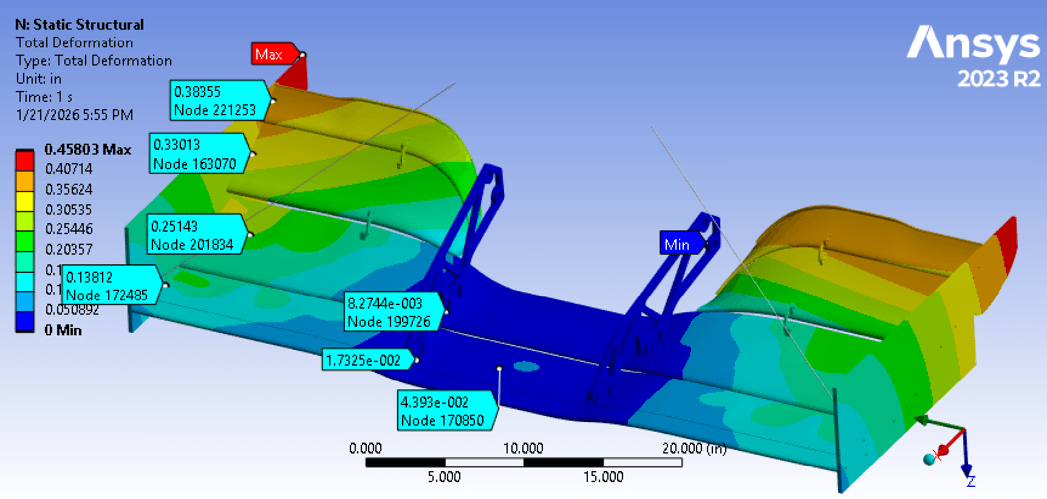
FSAE | AERO-ELASTICITY & MASS OPTIMIZATION
Structures EngineerAug 2024 – Present
FSI - Star-CCM+ to AnsysAnsys ACPComposite Ply OptimizationAero-elasticity
"Implemented a one-way Fluid-Structure Interaction (FSI) workflow to map real CFD pressure fields onto composite FEA models for accurate deflection sizing. Iterated on ply schedules and internal layouts to hit a 5.86 lb assembly weight while minimizing aerodynamic performance loss."
Engineering Summary
The Problem
An arbitrary deflection target doesn't capture real aero performance loss — wing deformation alters airfoil shape, closes slot gaps, and changes angle of attack.
My Approach
Built a one-way FSI loop (Star-CCM+ → Ansys ACP) to map real CFD pressure fields onto composite FEA models, iterating on 6 internal architectures and ply schedules.
Key Result
Hit 5.86 lb assembly weight (well under 7.5 lb limit), kept deflection under 0.5" and Cl loss within acceptable margin.
Design Constraints & Specifications
Mass Limit7.5 lb total assembly
Deflection< 0.5" wing, < 0.1" struts at 95 mph
Aero PerformanceMinimize Cl loss from deformed geometry
MaterialTwill weave CFRP with Corecell M80 core
Engineering Deep Dive
To build a realistic physics model, I implemented a Fluid-Structure Interaction (FSI) workflow that could be used iteratively. We ran CFD in Star-CCM+ with all elements and endplates to get a baseline, then exported the pressure field data as a .csv file.
Pressure Mapping
I imported this into Ansys, defined the composite stack-ups using ACP (Ansys Composite PrepPost), and used pinball regions to map the pressures perfectly onto the skin.
Boundary Conditions
For a sanity check, I checked if the fixed-joint reaction forces equaled the CFD's total downforce and drag outputs. Finally, I solved the high-fidelity structural mesh, exported the deformed geometry, and ran it back through CFD to examine the actual C_l loss.
Considering we had a strict 7.5 lb mass limit for the entire assembly, I essentially tested about 6 different distinct internal architectures. I evaluated a 2 spar in each mainplane setup, a 1 spar in each mainplane, a complex cell-structure that was inspired from a youtube video (which was scrapped due to manufacturing concerns), and then with different material choices. We continuously tweaked the ply schedules, part by part, testing stiffness in different orientations to resist torsional twist vs flexural bending until we found the sweet spot. The output and design rationale for each part is mentioned below.
| Component | Material | Ply Schedule | Design Rationale |
|---|---|---|---|
| Mainplane 1 | Twill weave | [45, -45] | Torsional Stiffness |
| Mainplane 2 | Twill weave | [45, -45] | Torsional Stiffness |
| Elements | Twill weave | [0, 0] | Flexural Rigidity |
| Spars | Twill weave | [0, 0, 0, 0, 0] | Flexural Rigidity |
| Ribs | Twill weave | 1C1 [0.125" core] | Buckling Resistance |
| Mounting Inserts | 6061 Al | Buckling Resistance | |
| Endplates | Twill weave | [0, -30] | Flexural Rigidity |
We hit a final weight of just 5.86 lbs (including the aluminum struts), destroying the 7.5 lb constraint.
Kept wing deflection under 0.5" and strut deflection under 0.1" at 95 mph.
Successfully limited the Coefficient of Lift (Cl) loss to an acceptable margin.
Established a validated FSI workflow connecting Star-CCM+ directly to Ansys ACP.
CONTACT
Let's Build Something Great
I'm currently working at Tesla, but I'm excited about the possibilities for the upcoming summer! Whether you have a question about my work or want to discuss a project, my inbox is open.