The primary objective was to transition from assembly balancing to individual (internal) balancing. This shift aimed to eliminate the internal torsional flex inherent in assembly-balanced systems and allow for component interchangeability.
The design had to adhere to strict mechanical constraints defined by the material properties of 38MnVs6 High-Strength Steel:
1. Geometric Limits — The crankpin and web dimensions were constrained by bearing pressure limits (10-12 N/mm²) and bending stress thresholds.
2. Manufacturing Constraints — The design had to accommodate the forging process used at Force Motors, ensuring proper grain flow and fatigue resistance.
3. Performance Goal — Achieve a balancing rate close to 50% to neutralize static and couple unbalance at the source.
Back to Projects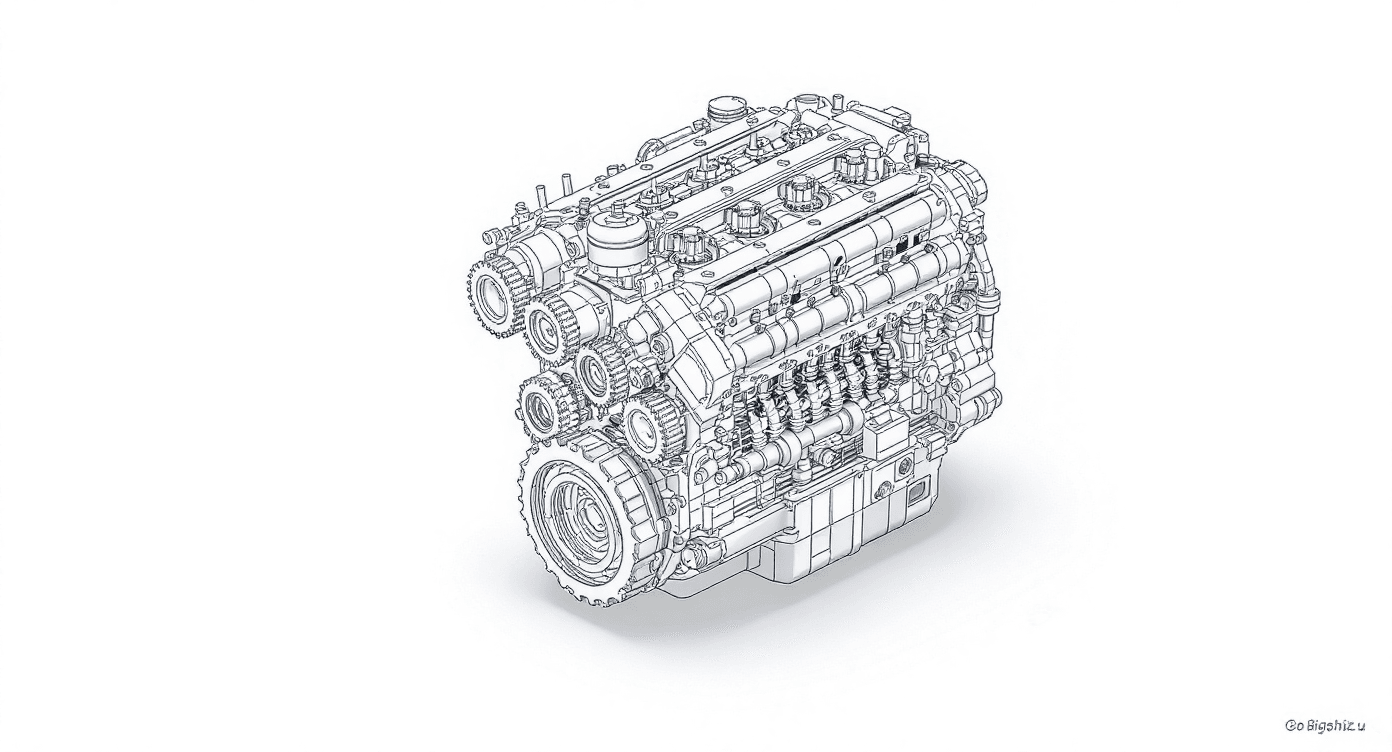
FORCE MOTORS | CRANKSHAFT PROTOTYPE
Mechanical Engineering InternJun 2025 – Aug 2025
Force Motors Powertrain Division
Analytical ModelingDesign ValidationPythonCATIA V5Automotive
"At Force Motors, I developed analytical frameworks to validate the design of a new individually-balanced 8-web crankshaft. My work focused on creating mathematical models for geometric constraints and balancing calculations, enabling design validation before physical prototyping."
Engineering Summary
The Problem
A new 8-web crankshaft prototype needed design validation before physical prototyping — geometry sizing, balancing, and fatigue life prediction.
My Approach
Built analytical models in Python for geometric stress limits and counterweight COG placement, validated against CATIA mass properties and ARAI fatigue testing.
Key Result
49.6% balancing rate (near-optimal), 58.63 g-mm residual unbalance (well below 250 g-mm tolerance), prototype survived 5M cycles at FOS 2.5.
Design Constraints & Specifications
Material38MnVs6 High-Strength Steel (forged)
Peak Pressure150 bar peak firing pressure (65.4 kN)
Balancing Target~50% rate for individual balancing
Industry Tolerance< 250 g-mm static unbalance
Engineering Deep Dive
I developed a mathematical framework to determine the minimum safe dimensions for critical features. This involved calculating stress vectors under peak combustion forces of 65.4 kN.
Crank Pin Analysis
Calculated minimum crankpin diameter based on allowable shear stress and bending moment from peak gas loads. The bearing pressure limits (10-12 N/mm²) constrained the journal-to-web ratio.
Crank Web Analysis
Determined crank web thickness required to withstand compressive loads at Top Dead Center. The web must transfer the full gas force from the crankpin to the main journals without yielding.
Main Shaft Analysis
Modeled the main shaft requirements to resist torsional stress when the connecting rod is at a 90-degree angle — the position of maximum torque transfer.
The geometric framework confirmed that the current design (150 bar peak pressure) fell within the safe regions for bending, shear, and compressive stress.
I built a physics model to quantify the system's inherent unbalance and design the necessary counterweights.
1. Extracted Mass and Center of Gravity (CoG) data for every component directly from CATIA.
2. Resolved the static and couple unbalance into X and Y vector components.
3. Iteratively designed counterweights to create opposing moments, targeting a net-zero unbalance state.
The pseudocode below shows the balancing rate calculation logic:
python
def calculate_balancing_rate(components, counterweights):
    """
    Calculates the balancing rate by comparing original vs. residual moments.
    Inputs extracted from CATIA models (Mass, Radius, Angle, Axial_Dist).
    """

    # 1. Calculate Inherent Unbalance (Static & Couple)
    # Static = m * r (Force)
    # Couple = m * r * l (Moment)

    total_static_x = 0
    total_static_y = 0
    original_moment_sum = 0

    for part in components:
        # Resolve forces into vectors
        fx = part.mass * part.radius * cos(part.angle)
        fy = part.mass * part.radius * sin(part.angle)

        # Sum forces (Static Unbalance)
        total_static_x += fx
        total_static_y += fy

        # Sum moments (Couple Unbalance)
        original_moment_sum += sqrt((fx * part.axial_dist)**2 + (fy * part.axial_dist)**2)

    # 2. Apply Counterweights (Opposing Force)
    residual_moment_sum = original_moment_sum

    for cw in counterweights:
        # Counterweights provide negative (opposing) vectors
        cw_moment = cw.mass * cw.radius * cw.axial_dist
        residual_moment_sum -= cw_moment

    # 3. Compute Balancing Rate
    # Target is 50% for optimal individual balancing
    balancing_rate = (1 - (residual_moment_sum / original_moment_sum)) * 100

    return balancing_rate

# Result obtained from model: 49.6%| Measurement | X (g-mm) | Y (g-mm) | Resultant (g-mm) |
|---|---|---|---|
| Static Unbalance | 12.80 | -57.22 | 58.63 |
| Couple Unbalance | -20.36 | 153.42 | 154.77 |
Balancing Rate: 49.6% — near the optimal 50% target for individual balancing
Static Unbalance Resultant: 58.63 g-mm — well below the 250 g-mm industry tolerance
Couple Unbalance Resultant: 154.77 g-mm — within acceptable limits
Design Robustness: All dimensions fell within safe stress limits for 150 bar operating pressure
Physical testing was conducted at ARAI (Automotive Research Association of India) to validate the analytical predictions.
Method: A high-frequency pulsator subjected the crankpins to alternating tensile (18 kN) and compressive (55 kN) loads.
Durability: The prototype survived the target of 5 million cycles at a Factor of Safety (FOS) of 2.5.
Failure Correlation: Samples tested at an extreme FOS of 3.0 failed exactly as predicted by our FEA models, confirming the accuracy of the simulation tools.
CONTACT
Let's Build Something Great
I'm currently working at Tesla, but I'm excited about the possibilities for the upcoming summer! Whether you have a question about my work or want to discuss a project, my inbox is open.