The OM606 connecting rod must survive three distinct loading scenarios. First: Peak Gas Load during combustion, where 130 bar cylinder pressure on an 87mm bore creates a compressive force of F_gas ≈ 77.3 kN — this drives the buckling constraint. Second: Top Dead Center Inertia at the end of the exhaust stroke, where the piston reverses direction and puts the rod in tension. The inertial force scales with ω², which is why I designed for 5500 RPM redline conditions. Third: Transverse Inertia (Whipping) at 90° crank angle, where lateral acceleration causes the rod to bow outward. Each load case produces different stress distributions and failure modes.
Back to Projects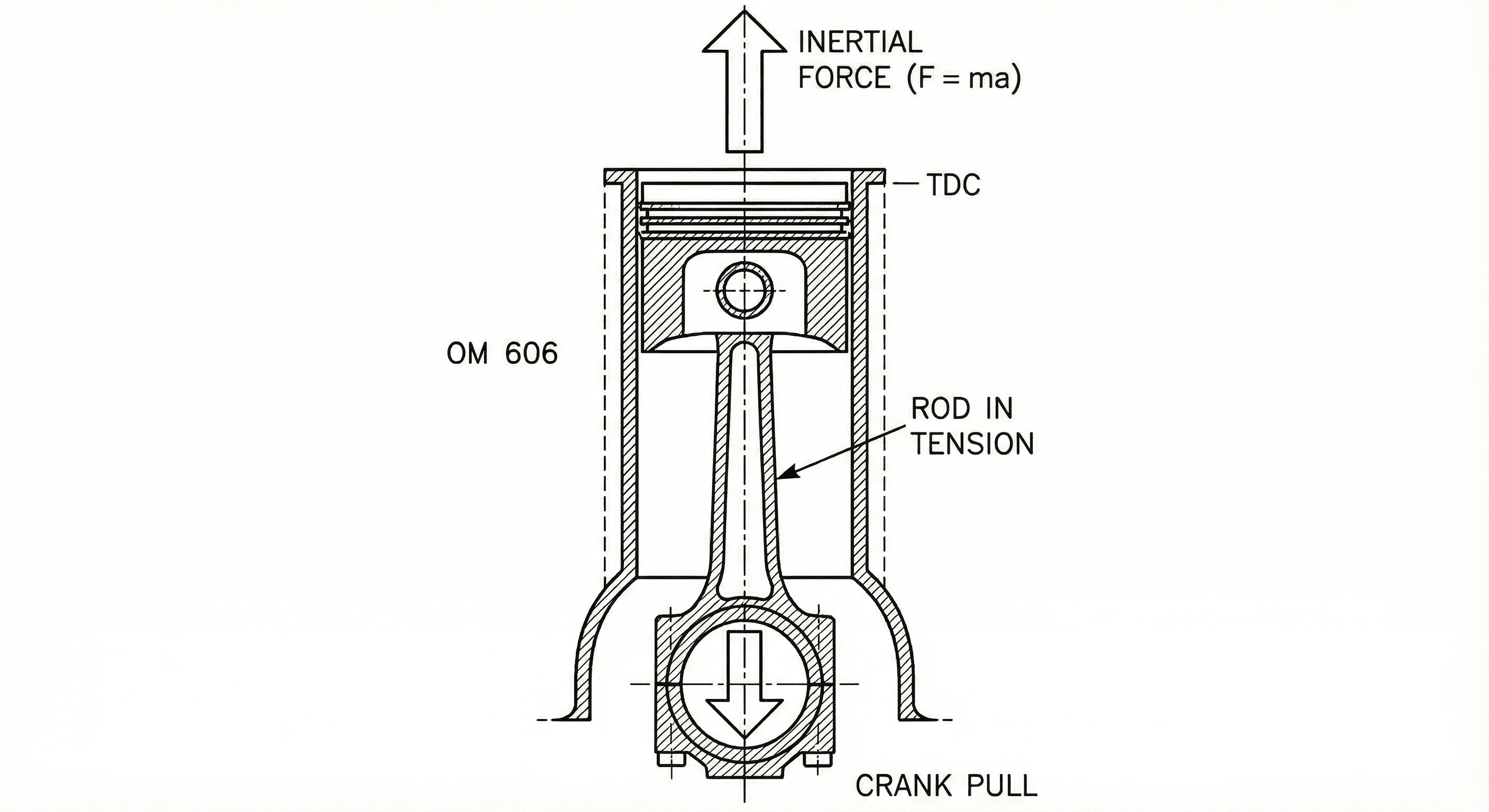
CONNECTING ROD MULTI-OBJECTIVE OPTIMIZATION
Personal ProjectAug 2025 – Dec 2025
OptimizationPythonBeam TheoryFEAAutomotive
"I developed a multi-objective optimization program to redesign the connecting rod of a Mercedes-Benz OM606 diesel engine. Using 1D beam modeling and Python, I minimized mass while maintaining structural integrity under extreme combustion loads."
Engineering Summary
The Problem
Redesign the connecting rod of a Mercedes-Benz OM606 diesel engine to minimize mass while maintaining structural integrity under 77.3 kN combustion loads.
My Approach
Built a 1D beam model in Python with SLSQP optimization, balancing buckling stability, fatigue life, static yield, and forging monotonicity constraints.
Key Result
I-beam converged to 88.34g (17.5% lighter than H-beam), with yield as the active constraint (SF 1.3) — buckling SF landed at 7.3, proving it was never the real limit.
Design Constraints & Specifications
Peak Gas Load77.3 kN (130 bar on 87mm bore)
Buckling SF≥ 2.5 (Euler critical load)
Fatigue SF≥ 1.3 under tensile inertial loading
Static Yield SF≥ 1.3 under compressive gas loading
ManufacturingMonotonic taper — no undercuts (forgeable)
Engineering Deep Dive
The objective was simple: minimize shank mass f(x) = Σρ A_i L_i while satisfying four constraints. Buckling stability required P_cr/(F_gas × 2.5) ≥ 1, where critical buckling load follows the Euler formula P_cr = π²EI/L². Fatigue life under tensile inertial loading needed SF ≥ 1.3. Static yield under compressive gas loading also required SF ≥ 1.3. Finally, a monotonicity constraint ensured the geometry tapered smoothly from small end to big end — no undercuts that would be impossible to forge. I solved this constrained NLP using SLSQP in scipy.optimize.
Going into this project, I assumed buckling would be the active constraint — that's what most textbooks emphasize for slender columns under compression. The post-optimization analysis told a different story. The optimized I-beam geometry achieved a Buckling Safety Factor of 7.3, nearly triple the requirement. Meanwhile, Static Yield converged to exactly 1.3 — it was the active constraint. This means the rod will crush under compressive stress long before it ever buckles. The I-beam flanges are so efficient at maximizing area moment of inertia that buckling became non-critical.
To validate the I-beam topology selection, I ran a comparative optimization using an H-beam cross-section under identical constraints. The H-beam configuration, with its vertical side walls instead of horizontal flanges, is geometrically less efficient at resisting in-plane buckling within the 35mm width constraint. The result: the H-beam converged to 103.8 g — a 17.5% mass penalty compared to the I-beam's 88.34 g. This performance gap conclusively demonstrated why I-beam sections dominate high-performance connecting rod design.
To visualize the optimized design, I translated the numerical output from my Python optimization code into a parametric CAD model. The shank geometry was modeled in Fusion 360, with each cross-section defined by the optimizer's output dimensions.
3/4 View — Optimized I-Beam Shank
The characteristic I-beam profile is visible here — wide flanges at top and bottom provide the area moment of inertia needed to resist buckling, while the thin web minimizes mass. Notice how the cross-section tapers smoothly from the small end (top) to the big end (bottom).
Front View — Cross-Section Evolution
This orthographic view clearly shows the concave curvature of the flanges along the shank length. The optimizer determined that material is most efficiently placed at the ends of the shank, where bending moments are highest under inertial loading.
Alternate 3/4 View
The smooth loft between varying I-beam cross-sections demonstrates the monotonicity constraint in action — no undercuts or sudden transitions that would complicate forging or create stress concentrations.
CONTACT
Let's Build Something Great
I'm currently working at Tesla, but I'm excited about the possibilities for the upcoming summer! Whether you have a question about my work or want to discuss a project, my inbox is open.